On http://get.info.bg/sport/Dir.asp?d=0-3-Fencing came across this history of Bulgarian fencing tidbit: "On 26 September 1931 in Sofia is held the first Balkan tournament in fencing in which participate: Greece, Turkey and Bulgaria."
To put this in modern perspective, this would be similar to a 1975 Middle Eastern Fencing League tournament with entries from Israel, Palestine, Jordan, Egypt, and Syria.Arabia.
Friday, April 28, 2006


Tuesday, April 25, 2006
Seattle Times Investigation into Abuse by Counselors
The Seattle Times has been running a series on misconduct and abuse charged to professional counsellors. I was surprised to learn that in Washington state a "registered counselor" is simply any person who has filled out an applications , paid the fee, and passed the background check. From then on, a registered counselor can set up shop as a therapist or work in a treatment center. The Seattle Times suggests that there should be more accreditation standards, more similar to that of psychologists and family counselors, because, as it stands, the person who does nails has to undergo more formal training, supervision, and testing. Unfortunately, the evidence suggests that formal education and certified training does not prevent patients from abuse.
Sounds good, except it seems that professional training and accreditation does not seem to prevent misconduct. Psychologists (10 per thousand) and chiropractors (9.8 per thousand) have the highest rate of abuse and nurses the lowest (0.3 per thousand). Registered counselors fall somewhere in the upper middle, and physicians in the lower middle. See the Seattle Times chart.
It seems that the potential for patient abuse is more tied to the type of person who chooses a particular health profession than the actual profession itself. In addition, nurses, while spending more time with an individual patient (possibly 8 hours per day), abuse patients substantially less often than psychologists or chiropractors who spend considerably less time with a individual patient (usually less than one hour a week).
Working against my argument that nurses are inherently better people, is the nature of their work environment. Nurses work as team to take care of patients. Nurses have supervisors and specialists, and they document and check on what they are doing to the patients. Psychologists and chiropractors work alone with patients, and no one checks their notes; at least not until the matter winds up in court.
Sounds good, except it seems that professional training and accreditation does not seem to prevent misconduct. Psychologists (10 per thousand) and chiropractors (9.8 per thousand) have the highest rate of abuse and nurses the lowest (0.3 per thousand). Registered counselors fall somewhere in the upper middle, and physicians in the lower middle. See the Seattle Times chart.
It seems that the potential for patient abuse is more tied to the type of person who chooses a particular health profession than the actual profession itself. In addition, nurses, while spending more time with an individual patient (possibly 8 hours per day), abuse patients substantially less often than psychologists or chiropractors who spend considerably less time with a individual patient (usually less than one hour a week).
Working against my argument that nurses are inherently better people, is the nature of their work environment. Nurses work as team to take care of patients. Nurses have supervisors and specialists, and they document and check on what they are doing to the patients. Psychologists and chiropractors work alone with patients, and no one checks their notes; at least not until the matter winds up in court.
Tuesday, April 18, 2006
Earthquake Commeration
A participant in the 10th anniversary takes the day off from work to attend the 100th anniversary festivities. He was three years old when the quake hit: from the SF Chronic--"Herb Hamrol, 103, has a shorter trip. He's still working two days a week stocking shelves at Andronico's, an upscale supermarket in San Francisco.
"I enjoy what I do," said the centenarian, who introduced himself with a firm handshake on a recent Thursday morning. His tie is perfectly knotted, his green apron crisp.
Hamrol has a job that requires the stamina of someone, say, 70 years younger. It's a second career for Hamrol, who retired as a grocer in 1967, when he was in his 60s."
"I enjoy what I do," said the centenarian, who introduced himself with a firm handshake on a recent Thursday morning. His tie is perfectly knotted, his green apron crisp.
Hamrol has a job that requires the stamina of someone, say, 70 years younger. It's a second career for Hamrol, who retired as a grocer in 1967, when he was in his 60s."
Cold Days in San Francisco
I am constantly annoyed by the out of towners who visit San Francisco and chatter non-stop about its European style cafes and bistros. Like many people from Oakland, while fed up with how San Franciscans always seem so full of themselves, I feel compelled to defend San Francisco from the yuppie barbarians. The appearance of the chi chi restaurants and fragile bars in San Francisco spelled the beginning of the end to an era of cheap eats and easy going camaraderie.
San Francisco has its own culinary traditions. Hofbraus are popular cafeterias where a working person can enjoy an inexpensive but hearty sandwich with a refreshing draft beer. My favorite has always been Lefty O'Doul's on Geary across from the St. Francis hotel. Also on Geary, but on the other side of the Tenderloin (in the evening, don't walk there , take a cab) is the Edinburgh Castle, which was a fine place to relax and unwind after a night's fencing down the block, next to the peep show bookstore, at the old Pannonia Fencing Club.
More upscale, but still part of the San Francisco food scene are the cold day restaurants, the original being, of course, Tadich's Grill on California in the financial district. John's Grill, also in the financial district, while technically not a cold day saloon, still has that same reassuring feeling of old dark wood, brass, and a staff of flinty waiters to match. The cold day name comes from obscure 19th century politicians swearing that it would be a cold day if they weren't re-elected. However, well until the late 20th century, bartenders in respectable San Francisco establishments could still be heard to tell ignorant newcomers and tourists that it would be a cold day in hell when they would ever serve a drink from a blender.
San Francisco has its own culinary traditions. Hofbraus are popular cafeterias where a working person can enjoy an inexpensive but hearty sandwich with a refreshing draft beer. My favorite has always been Lefty O'Doul's on Geary across from the St. Francis hotel. Also on Geary, but on the other side of the Tenderloin (in the evening, don't walk there , take a cab) is the Edinburgh Castle, which was a fine place to relax and unwind after a night's fencing down the block, next to the peep show bookstore, at the old Pannonia Fencing Club.
More upscale, but still part of the San Francisco food scene are the cold day restaurants, the original being, of course, Tadich's Grill on California in the financial district. John's Grill, also in the financial district, while technically not a cold day saloon, still has that same reassuring feeling of old dark wood, brass, and a staff of flinty waiters to match. The cold day name comes from obscure 19th century politicians swearing that it would be a cold day if they weren't re-elected. However, well until the late 20th century, bartenders in respectable San Francisco establishments could still be heard to tell ignorant newcomers and tourists that it would be a cold day in hell when they would ever serve a drink from a blender.
Friday, April 14, 2006
San Francisco Earthquake
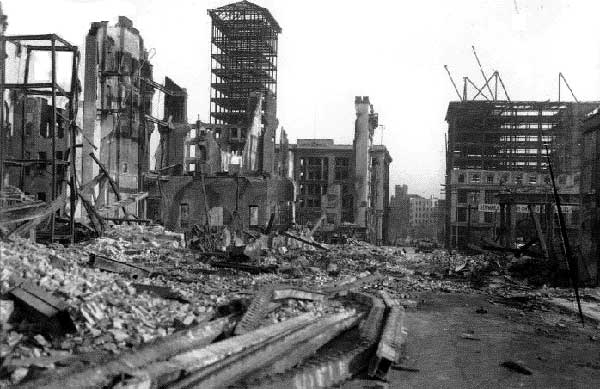
April 18, 1906 at 5:12 AM San Francisco was struck by a devastating earthquake. Gas and water lines ruptured, and by the mid-afternoon a super heated fire started consuming the city. The San Francisco Fire Department, perhaps the world's best equipped and trained fire fighting force, was helpless, lacking any water to stop the raging fire. In attempt to mount containment and rescue missions, San Francisco firefighters were incinerated in "fire proof" skyscrapers.
Chaos and anarchy was subdued, perhaps illegally, by troops under General Funston's command. The army shot looters on sight and in a desperate attempt to stop the fast spreading fire, dynamited and shelled buildings to create firebreaks. Over 400,000 people were left homeless, and the city government and military deliberately under reported the death toll to 700. The true toll of over 3,000 killed would not be determined until the 1980s, when an enterprising historian simply counted the headstones marked April 1906.
The San Francisco earthquake was perhaps the first mass natural disaster caught on film, yet attitudes were different in that era, certainly more rooted in the 19th century rather than the 20th. In the public squares and parks, the homeless people living in tents were not pitiful refugees or survivors, and instead of being portrayed as traumatized victims they were San Franciscans simply making do in frontier fashion in much the same way as the '49ers had. Instead of providing grief counseling, the government press ganged citizens into work crews. No one thought it strange or out of place that the press tycoon William Randolph Hearst made his way to the charred and smoldering remains of the city in order to provide the latest news and impressions of the devastation:"The hills rolled to the seas as bare as when the pioneers landed in '49. But now they are a blackened waste. North to the bay, west to the Mission -- nothing but ruins. The wholesale district is destroyed, the manufacturing district, the financial district, and the waterfront section -- all destroyed."

San Francisco rose again from the ashes and celebrated its re-birth by hosting the the 1915 World's Fair. The war in Europe was far away, and San Franciscans had fought their own battle and had won. While Europe would never be the same, San Francisco regained its position as one of the leading cities of commerce, culture, and finance in the Pacific. No San Franciscan could imagine that their shining, modern city would one day be eventually eclipsed by Los Angeles.
I used to see the gathering of earthquake survivors at the downtown commemoration. Their numbers diminished every year, and I imagine the turnout will be sparser this year. The earthquake survivors provided us with memories not only of the earthquake, but of what San Francisco once was before two world wars and a half century of social change.
Naturally, there was speculation back then that the earthquake was sign of divine retribution. Before North Beach and the Castro district, there had been the wicked Barbary Coast, and many preachers connected the earthquake to San Francisco's tolerance of human nature. To refute this view, Herb Caen always loved to re-print this old and true ditty:
"If, as they say, God spanked this town
For being much too frisky,
Why did He burn His churches down
And save Hotaling's Whiskey?"
Indeed, the firestorm somehow bypassed Hotaling's warehouse on Jackson St. saving thousands of barrels of flammable liquor.
Wednesday, April 12, 2006
Leilani Lanes Closes in Seattle
With it's Polynesian motif, this was by far my favorite bowling alley. The new high tech and blue neon places don't compare to throwing a trike under the gaze of tiki head. The Seattle Times: Local News: Leilani Lanes auctions kitsch and memories: "She remembered how one couple, whose last name was 'Lane,' named their daughter 'Leilani.'"
Tuesday, April 11, 2006
Orwell on Socialism
As much as George Orwell believed in democratic socialism, he felt that what held socialism back were the insufferable socialists. Pity he didn't live long enough to write about the hippies, but I think I know what he would've said. (By the way, what was on Orwell doing on that bus?)
From Geroge Orwell's Road to Wigan Pier:
"Question a person of this type, and you will often get the semi-frivolous answer: ‘I don’t object to Socialism, but I do object to Socialists.’ Logically it is a poor argument, but it carries weight with many people. As with the Christian religion, the worst advertisement for Socialism is its adherents.
The first thing that must strike any outside observer is that Socialism, in its developed form is a theory confined entirely to the middle classes. The typical Socialist is not, as tremulous old ladies imagine, a ferocious-looking working man with greasy overalls and a raucous voice. He is either a youthful snob-Bolshevik who in five years time will quite probably have made a wealthy marriage and been converted to Roman Catholicism; or, still more typically, a prim little man with a white-collar job, usually a secret teetotaller and often with vegetarian leanings, with a history of Nonconformity behind him, and, above all, with a social position which he has no intention of forfeiting. This last type is surprisingly common in Socialist parties of every shade; it has perhaps been taken over en bloc from the old Liberal Party. In addition to this there is the horrible—-the really disquieting—-prevalence of cranks wherever Socialists are gathered together. One sometimes gets the impression that the mere words ‘Socialism’ and ‘Communism’ draw towards them with magnetic force every fruit-juice drinker, nudist, sandal-wearer, sex-maniac, Quaker, ‘Nature Cure’ quack, pacifist, and feminist in England.
One day this summer I was riding through Letchworth when the bus stopped and two dreadful-looking old men got on to it. They were both about sixty, both very short, pink, and chubby, and both hatless. One of them was obscenely bald, the other had long grey hair bobbed in the Lloyd George style. They were dressed in pistachio-coloured shirts and khaki shorts into which their huge bottoms were crammed so tightly that you could study every dimple. Their appearance created a mild stir of horror on top of the bus. The man next to me, a commercial traveller I should say, glanced at me, at them, and back again at me, and murmured ‘Socialists’, as who should say, ‘Red Indians’. He was probably right-—the I.L.P. [Independent Labor Party-jj] were holding their summer school at Letchworth. But the point is that to him, as an ordinary man, a crank meant a Socialist and a Socialist meant a crank. Any Socialist, he probably felt, could be counted on to have something eccentric about him. And some such notion seems to exist even among Socialists themselves. For instance, I have here a prospectus from another summer school which states its terms per week and then asks me to say ‘whether my diet is ordinary or vegetarian’. They take it for granted, you see, that it is necessary to ask this question. This kind of thing is by itself sufficient to alienate plenty of decent people. And their instinct is perfectly sound, for the food-crank is by definition a person willing to cut himself off from human society in hopes of adding five years on to the life of his carcase; that is, a person out of touch with common humanity."
From Geroge Orwell's Road to Wigan Pier:
"Question a person of this type, and you will often get the semi-frivolous answer: ‘I don’t object to Socialism, but I do object to Socialists.’ Logically it is a poor argument, but it carries weight with many people. As with the Christian religion, the worst advertisement for Socialism is its adherents.
The first thing that must strike any outside observer is that Socialism, in its developed form is a theory confined entirely to the middle classes. The typical Socialist is not, as tremulous old ladies imagine, a ferocious-looking working man with greasy overalls and a raucous voice. He is either a youthful snob-Bolshevik who in five years time will quite probably have made a wealthy marriage and been converted to Roman Catholicism; or, still more typically, a prim little man with a white-collar job, usually a secret teetotaller and often with vegetarian leanings, with a history of Nonconformity behind him, and, above all, with a social position which he has no intention of forfeiting. This last type is surprisingly common in Socialist parties of every shade; it has perhaps been taken over en bloc from the old Liberal Party. In addition to this there is the horrible—-the really disquieting—-prevalence of cranks wherever Socialists are gathered together. One sometimes gets the impression that the mere words ‘Socialism’ and ‘Communism’ draw towards them with magnetic force every fruit-juice drinker, nudist, sandal-wearer, sex-maniac, Quaker, ‘Nature Cure’ quack, pacifist, and feminist in England.
One day this summer I was riding through Letchworth when the bus stopped and two dreadful-looking old men got on to it. They were both about sixty, both very short, pink, and chubby, and both hatless. One of them was obscenely bald, the other had long grey hair bobbed in the Lloyd George style. They were dressed in pistachio-coloured shirts and khaki shorts into which their huge bottoms were crammed so tightly that you could study every dimple. Their appearance created a mild stir of horror on top of the bus. The man next to me, a commercial traveller I should say, glanced at me, at them, and back again at me, and murmured ‘Socialists’, as who should say, ‘Red Indians’. He was probably right-—the I.L.P. [Independent Labor Party-jj] were holding their summer school at Letchworth. But the point is that to him, as an ordinary man, a crank meant a Socialist and a Socialist meant a crank. Any Socialist, he probably felt, could be counted on to have something eccentric about him. And some such notion seems to exist even among Socialists themselves. For instance, I have here a prospectus from another summer school which states its terms per week and then asks me to say ‘whether my diet is ordinary or vegetarian’. They take it for granted, you see, that it is necessary to ask this question. This kind of thing is by itself sufficient to alienate plenty of decent people. And their instinct is perfectly sound, for the food-crank is by definition a person willing to cut himself off from human society in hopes of adding five years on to the life of his carcase; that is, a person out of touch with common humanity."
Saturday, April 08, 2006
Passive Agressive Seattle Landlord
Wallingford Center has been languishing the last two years, with merchants driven out by higher rents and ongoing and never ending renovation. The property owner won't come out and say what he is up to, but prefers to be coy. Merchants instead of calling their landlord a jackass speak, instead speak vaguely of decreasing foot traffic. Another marvelous example of Seattle's culture of passive aggression: Retail Notebook: Renovation tests patience of merchants, shoppers
Subscribe to:
Posts (Atom)